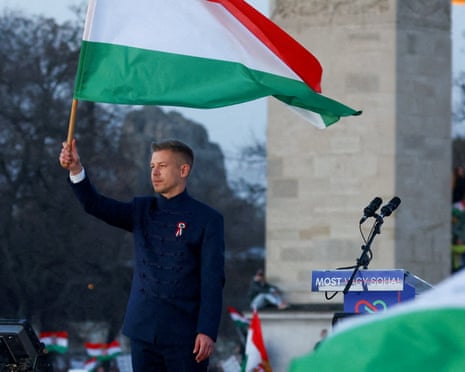
Péter Magyar and his opposition Tisza party swept to power in Hungary on Sunday, decisively ending Viktor Orbán’s 16-year premiership. The result, confirmed after a record 78% voter turnout, signals a radical realignment for the nation and a stinging defeat for the global far-right movement.
With 97.35% of precincts reporting, the Tisza party secured 138 seats in the 199-seat parliament with 53.6% of the vote, while Orbán’s Fidesz party trailed with 55 seats and 37.8%, according to Al Jazeera. This legislative supermajority grants the new government the power to dismantle the constitutional and institutional framework Orbán established since 2010.
Orbán acknowledged the defeat in a statement to his supporters. “I congratulate the victorious party,” he said, characterizing the loss as “painful” before vowing to lead his movement from the opposition benches.
A pivot toward Europe
For more than a decade, Orbán utilized his mandate to build what he termed an “illiberal democracy.” His administration frequently clashed with Brussels over democratic standards, maintained close strategic ties with Moscow, and frustrated EU leaders by vetoing strategic actions, including a 90-billion-euro loan for Ukraine, according to AP News. Magyar’s campaign centered on a promise to reverse this trajectory, targeting state corruption and pledging to mend relations with the European Union.
Magyar, 45, is a former Fidesz loyalist born into a family of lawyers; he is the great-nephew of former Hungarian President Ferenc Mádl, Al Jazeera reported. During his victory speech to tens of thousands of supporters along the Danube River, he declared, “Tonight, truth prevailed over lies,” adding, “Today, we won because Hungarians didn’t ask what their homeland could do for them; they asked what they could do for their homeland.”
European leaders now look to the transition with optimism. Olga Oliker, director of European Security at the International Crisis Group, noted that Magyar could help shape the future of Europe by ending the obstructionism that defined the previous administration. After taking his oath of office in May, Magyar could potentially lift Hungary’s veto on critical EU initiatives, AP News reported.
In Budapest, the results prompted public celebrations. Nori, a 24-year-old voter, described the outcome as a liberation. “This dictatorship, its right-wing ideology and all of that will disappear now,” she said. “We have the opportunity for a country close to Europe, to move toward the West and stop fighting imaginary enemies.”
Orbán’s fall reverberates far beyond Hungary’s borders. As one of the European Union’s longest-serving leaders, he served as a primary model for nationalist movements globally. His campaign received high-profile endorsements from figures including Donald Trump and Italian Prime Minister Giorgia Meloni. Political analysts suggest the defeat weakens the symbolic axis of the international far-right, as the movement faces new questions regarding the viability of its governance model.
While the mandate is clear, the path forward is difficult. Magyar must now navigate a nation where the political, economic, and media systems were fundamentally reshaped by the previous administration. Although Magyar avoided specific campaign rhetoric regarding Ukraine or divisive social issues like LGBTQ rights, voters in the capital expressed caution, noting that the coming years will require significant effort to undo the deep-seated tensions left behind by the Orbán era.