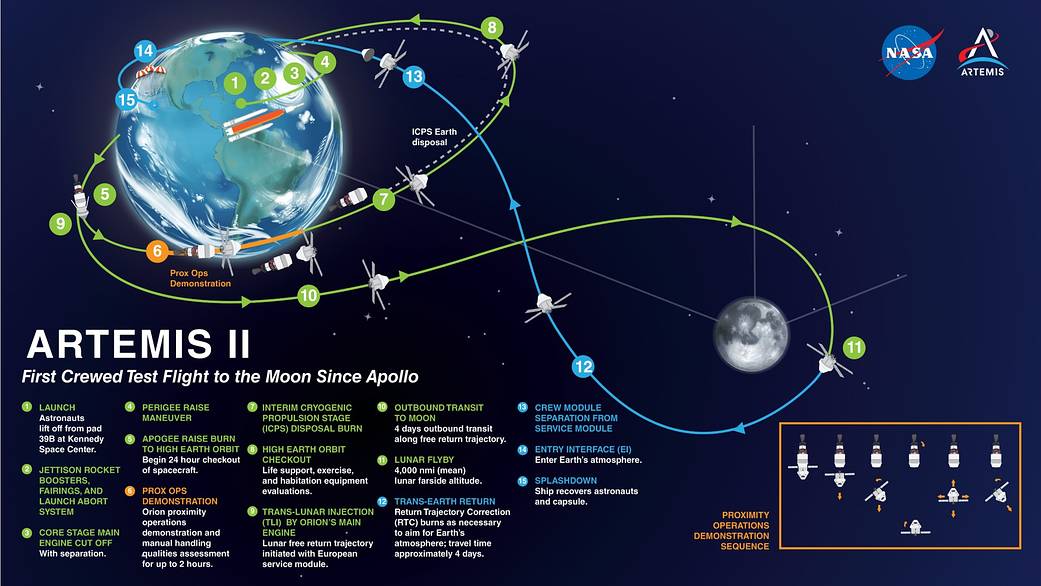
Four astronauts aboard the Orion spacecraft reached a record-breaking distance of 406,771 kilometers from Earth this Tuesday at 7:02 p.m. This milestone places the crew 6,600 kilometers further into space than the previous record held by the 1970 Apollo 13 mission.
The mission serves as a critical test for the Artemis program, validating life support and navigation systems required for deep-space travel. By keeping the crew safe for ten days, NASA aims to prove the vehicle is ready for direct descents to the lunar surface, moving away from reliance on orbital waystations.
Shifting from orbit to habitation
NASA is pivoting its strategy from the proposed “Lunar Gateway” station toward a direct-to-surface approach dubbed “Ignition.” The agency now aims to establish a permanent base at the lunar south pole by 2030. This shift requires international partners, including the European Space Agency and the Japan Aerospace Exploration Agency, to adapt their hardware from orbital modules to surface infrastructure.
Energy remains the primary obstacle for long-term habitation. Because solar power cannot sustain operations during the 14-day lunar night or power ice-extraction machinery, NASA is developing a nuclear fission reactor for the site. This technology would allow the lunar base to function as an industrial hub rather than a temporary scientific outpost.
The current push into space reflects a shift in geopolitical priorities compared to the Cold War era. While the 1960s were defined by a binary competition for prestige, the modern era is driven by the race for resource sovereignty. China is actively pursuing its own lunar landing by 2030 through its CLEP program and is coordinating with Russia, Pakistan, and South Africa to establish an alternative international base.
Experts note that this transition marks a new era of space utilization. “What once seemed unreachable is becoming a territory of trial, presence, and dispute,” according to contributors from the University of Chile and the Chilean Air Force. As the mission progresses, the reliance on private sector partners like SpaceX and Blue Origin highlights how commercial interests are now central to national space strategies.