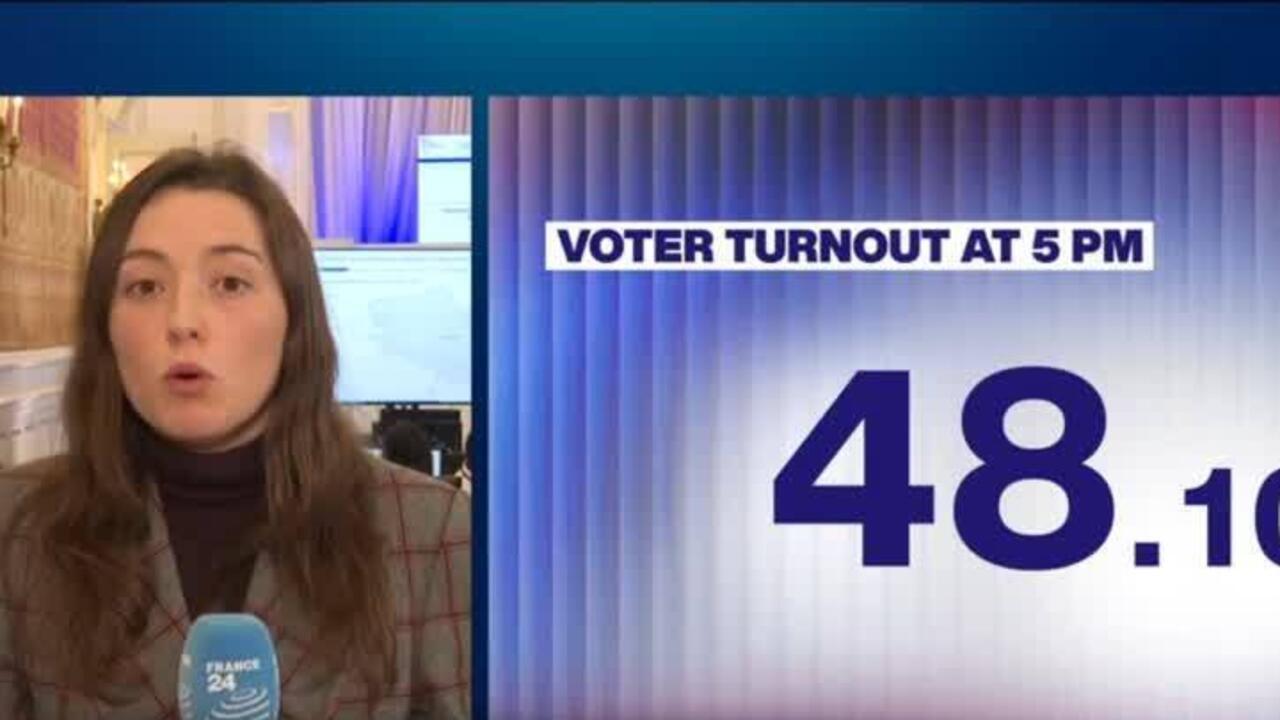
Paris registered a noticeable increase in voter activity by midday on Sunday, March 22, 2026.
Observers noted a shift from the historically low participation seen during the initial local election round last week.
This uptick suggests a renewed public engagement across several key urban centers in the nation.
Analysts suggest the trend could signal a recovery in civic trust following recent political volatility.
Queues formed at major polling stations, indicating higher demand than expected.
FRANCE 24 correspondent Jamie Smith-Maillet reported from the capital regarding the midday statistics.
She observed that polling stations in major metropolitan areas opened with significantly more citizens than anticipated.
The data indicates a potential correction to the apathy displayed during the first phase of the ballot.
This observation provides critical real-time insight into the electorate's mood.
Her report highlights the urgency of the situation on the ground.
Participation rates appear to be rising compared to the 2014 and 2020 local election cycles.
Early metrics show a modest gain in voter turnout percentages relative to previous years in similar contexts.
While not yet matching historical highs, the trajectory marks a distinct improvement over the disappointing Sunday numbers.
Such data points are vital for understanding the current political climate.
Specific cities like Lyon and Marseille showed similar positive trends.
The initial round of voting suffered from record low turnout figures across the country.
Many observers cited economic uncertainty and political fatigue as primary drivers for the abstention rate.
This context is essential for interpreting the recent midday surge in activity.
Without this background, the current figures might appear misleading to international readers.
Economic instability often correlates with reduced civic participation in democratic processes.
Political stability remains a key concern for markets watching French policy continuity.
Investor confidence often hinges on the perceived legitimacy of local governance bodies.
A stronger turnout could suggest a mandate for current administrative strategies.
Conversely, continued low engagement might signal deeper dissatisfaction with the political establishment.
Financial sectors are closely monitoring the risk premium associated with the region.
Regional implications extend beyond national borders within the European Union framework.
France serves as a major economic anchor for the region, making its internal stability relevant to neighbors.
Changes in local leadership could ripple through trade agreements and regulatory frameworks.
Geopolitical analysts are monitoring the situation closely for signs of broader unrest.
Neighboring nations rely on French output for broader European economic forecasts.
Government officials have not yet commented on the statistical shifts in real time.
Reports indicate that final results will be consolidated later in the evening of the voting day.
Officials expect the data to provide a clearer picture of public sentiment.
The timing of the release will influence subsequent policy announcements.
Delays in communication could exacerbate market uncertainty among foreign stakeholders.
Future election cycles will likely depend on how officials manage the current momentum.
Maintaining voter interest is crucial for preventing future abstention spikes.
Campaign strategies may adjust based on these emerging participation trends.
The coming weeks will reveal whether this uptick was temporary or sustained.
Resource allocation for next phases will reflect these preliminary observations.
International observers will track the final numbers for signs of democratic health.
Consistency in reporting ensures that global stakeholders understand the domestic situation.
Transparency remains a priority for maintaining international credibility.
The outcome will shape the narrative for the remainder of the electoral term.
Independent verification bodies will assess the integrity of the voting process.
Markets and diplomatic circles will await the official certification of results next week.
Any significant deviation from the midday trends could alter investment forecasts.
Stakeholders are advised to monitor official channels for definitive confirmation.
The situation remains fluid as voting concludes across the nation.
Future policy shifts depend on the finalized electoral outcome.